
Reaching younger audiences: lessons from the V&A
Giving Gen Alpha and Gen Z what they want

If there’s one phrase that gets thrown around in our sector, it’s “meet audiences where they are”. But what does that actually look like in practice?
Kati Price is Head of Experience and Digital at the V&A. In this guest post, Kati shares how the V&A built Mused, a content platform for 10- to 14-year-olds that’s reached over 2.5 million users, and how the museum is rethinking its YouTube strategy to reach younger audiences.
If you’re thinking about how to reach new audiences with digital content, there’s a lot to be inspired by here.
Here’s Kati.
The audience disconnect
Museums play a vital role in shaping and sharing culture, but we don’t always communicate or understand it the same way our audiences do.
We often begin with what we have: a venue, an exhibition, a collection, a programme, and then think about how we communicate it online.
But that’s starting from our perspective, not theirs.
When we flipped that and started with audiences instead, we found something quite different. Younger audiences care deeply about culture, just not necessarily in the way we organise and present it online. They search, they scroll, they discover via algorithms. They’re looking for things that feel engaging, relevant and shareable.
Starting with listening
To inform our work targeting younger audiences, we set up a panel of 12 Gen Alpha and Gen Z trend spotters who kept online diaries documenting their cultural consumption.
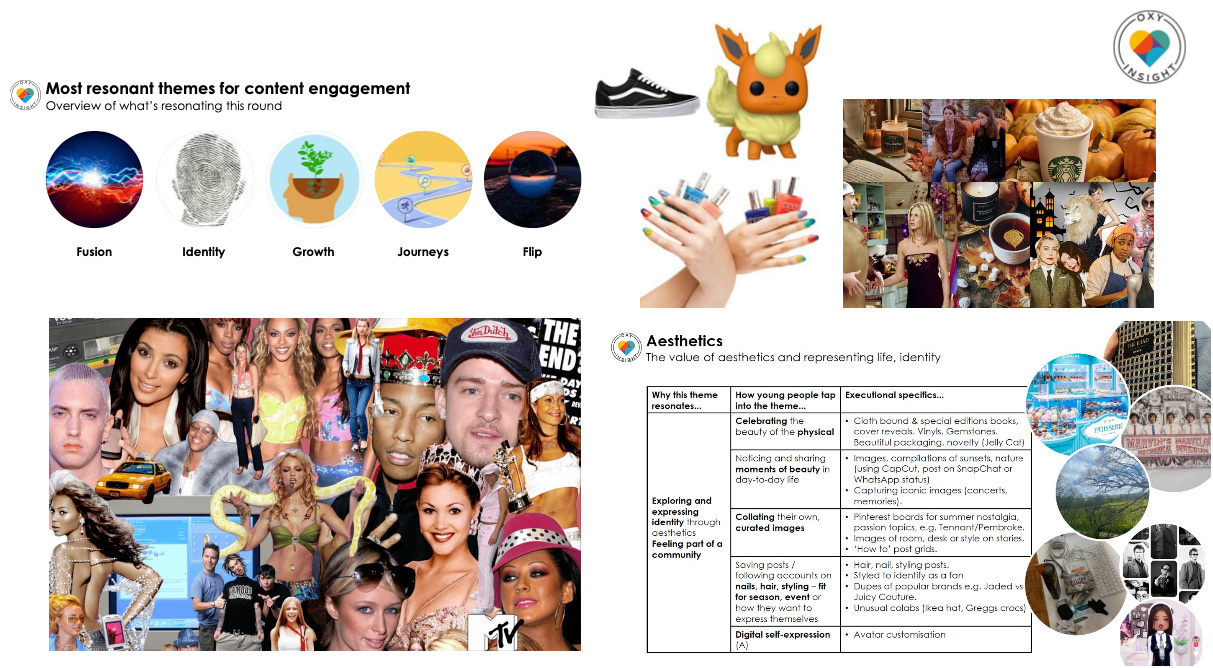
We heard that they’re into fashion, aesthetics, and Harry Styles and glow-ups. They’re concerned about the political landscape, climate change and AI.
They like short form, snackable content, but they also like slow, satisfying content that dives into niche interests. Humour plays a huge part in their online lives too.
Crucially, these trend spotters didn’t know they were working for the V&A. Recruited and managed by Sonja Joao and the team at Oxy Insight, they gave their honest views about what they think culture is and what it means to them.
We also analysed search behaviours. Search data shows us what people care about right now, which means we can spot trends early and create content around them.
For instance, we'd heard from our trend spotters about different fashion 'cores', those hyper-specific fashion trends that define a particular style, and we could see them taking off in the search data.
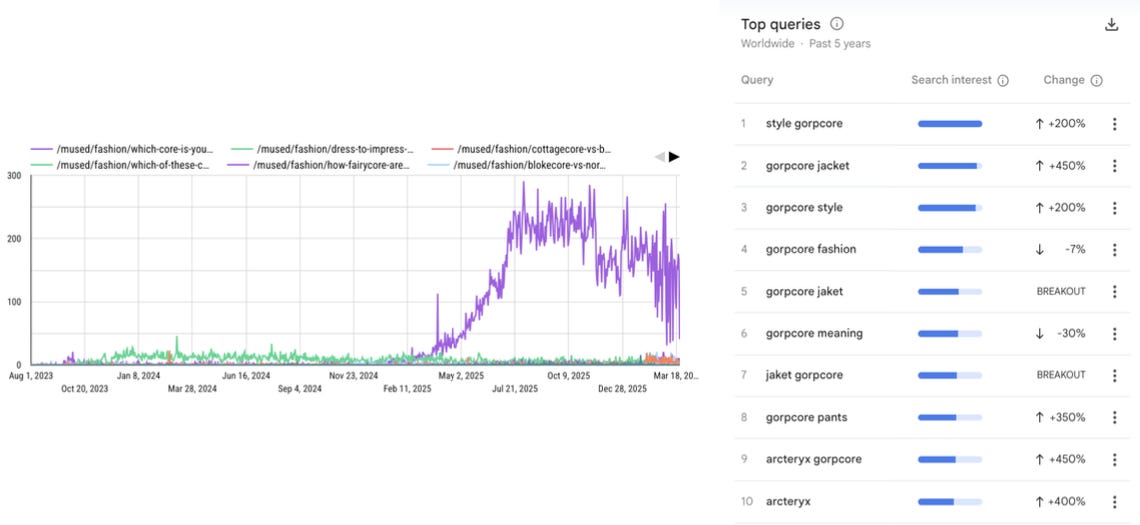
Whether it’s hearing from people or looking at search data and analytics, this is all about moving from broadcasting to listening.
This research, generously funded by Bloomberg Digital Philanthropies, showed not just the what but the why behind younger audiences’ cultural consumption online: things like social currency, a sense of mastery in their areas of interest and finding new ways to define their identity.
Building Mused
We also discovered that while there are plenty of digital products for younger children, this critical age group, closely aligned with the target audience for Young V&A, had very little designed for them online – for their interests, their needs, and how they spend their time.
That led us to build Mused, a content platform aimed at 10 to 14-year-olds.
People of that age aren’t supposed to be on social media (though we all know they might be). So instead, we focused on creating a space filled with content informed by search and audience insights, packaged in formats that feel familiar: personality quizzes, challenges and listicles.
Those formats are deliberate. They reflect what we learned about audience motivations. Social currency and a sense of mastery show up in how young people engage – knowing every Pokémon character or the finer points of a Harry Potter plot isn’t just knowledge, it’s something to share and show. That’s where challenges and listicles come in. And the desire to explore and express identity is why personality quizzes work so well – whether that’s discovering which Taylor Swift era you are, or what kind of designer you might be.
It has a visual identity and user experience designed to feel like the types of experiences young audiences already consume online.

And it worked. We’ve engaged over 2.5 million active users since it launched in autumn 2023, with a 76% engagement rate and really high dwell times.
Keeping the content engine running
For Mused, we deliberately chose simple formats, quizzes and listicles rather than video, because they’re faster and cheaper to produce and let us be responsive.
We keep an eye on what’s coming up on Disney Plus, Netflix and the London stage, and create content around those moments. Some of it is trend-led bets, but other things (like Harry Potter) are always popular.
We were also really conscious that we didn’t want to create a site that kept people locked in for hours. It needs to be a worthwhile snack, something you dip into, leave, and come back to again. Keeping that content plan and momentum going is what drives repeat visits.
Reaching younger audiences on YouTube
Even with great content, we realised we might still not reach younger audiences if we weren’t showing up in the right places. Our existing content reached under-35s really well, but to reach under-24s (the target audiences for V&A East and Young V&A) we needed to do something different.
We now run two YouTube channels: one to maintain our existing audience, and one specifically to reach UK under-24s. The second channel, V&A Up Next, has new formats, new voices, and a different energy.
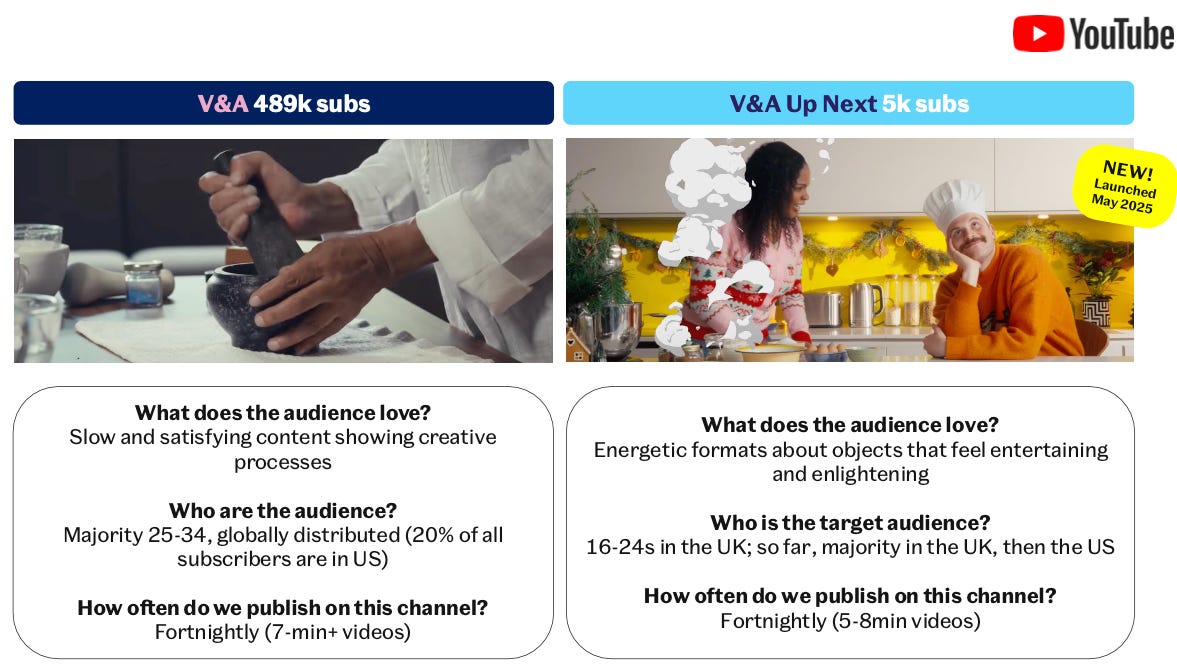
We use people as the bridge and emotion as the hook, because that’s what draws people in and makes the unfamiliar feel accessible.
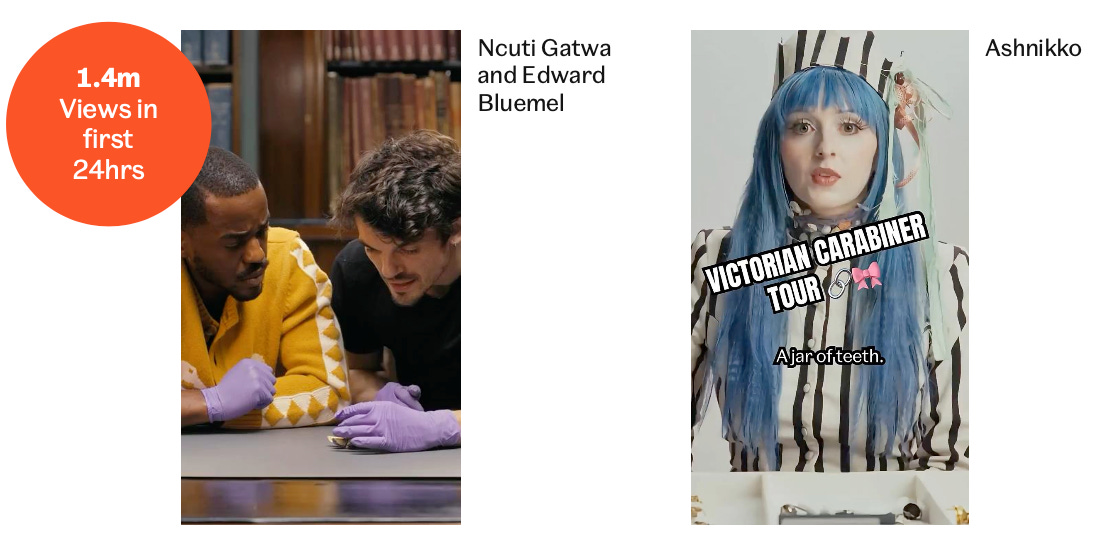
One format we’ve developed, Unexpected Item, is a video series where guests use museum objects to tell their own stories and show their influences and creativity. It creates a natural bridge back to the museum.
We’re also making conscious decisions about who gets to tell these stories.
Traditionally, across our institutions, it’s been curators. But (certainly for younger audiences) we think those stories are often more powerfully told by people with different types of lived experience.
We work with them to show their curiosity, to ask questions and have them answered. It’s not about devaluing curatorial expertise but about channelling it through voices that are more representative of the audiences we’re trying to reach.
We don’t always get it right
Not everything works.
We ran a Christmas live stream that replaced a log fire with looped crafting content. It didn’t land in the way we expected, but it taught us that even a novel format needs a clear concept and a strong connection to what people are looking for in that moment.
We’ve also learned that a big name alone isn’t enough. Formats like Unexpected Item work best when there’s a strong overlap between the guest, the subject matter and a clearly defined audience or cultural moment. Sometimes that means tapping into niche fandoms or communities in a way that still cuts through to more casual audiences. Getting that balance right is part of the work.
And sometimes you’re still left wondering why one thing takes off, and another doesn’t.
But occasionally something does break through in a way you couldn’t have planned, and it’s brilliant when that happens. Like when our curator, Angus, inadvertently referenced ‘6-7’ while talking about a vomit-inducing cup.

You can’t plan for virality. You can’t rely on it. But what you can design for is discoverability: showing up consistently in the formats people engage with, on the platforms they’re already using.
What to take away
There are more ways than ever for people to connect with culture, and our role is to make that connection easier, more relevant and more meaningful.
What we’ve been doing is essentially quite simple. Understanding our audiences. Designing around their needs. Reaching them where they are.
You don’t need to do everything. Start small: one audience, one idea, one format.
This post was based on a talk that Kati gave at the Museum Association’s recent Museum Tech Conference. You can follow Kati Price on LinkedIn.
Kati was also keen to point out the brilliant people who have worked on these projects, including:
Mused: BigByte Digital, Rebekah Ford, Eva Liparova, James Nation and most of all Jo Duggan, who leads on all the amazing content on Mused.
YouTube: Kirstie Beaven, Jamie Edmundson and Ruth Smith, who oversee V&A UpNext.
And JJ Dunning, the V&A’s Head of Digital Content.